Context
At Sam's Club, every return needed an associate. Members lined up at Member Services while an associate identified them, found the purchase, validated the return and processed the refund by hand.
It worked the same way for every return, however simple.
The problem
Simple returns were treated like complex ones. Members waited for help they often didn't need, while associates spent valuable time on routine transactions instead of the moments where their expertise mattered.
The opportunity: shift simple returns to self-service, and save associate expertise for the returns that truly need it.
The solution
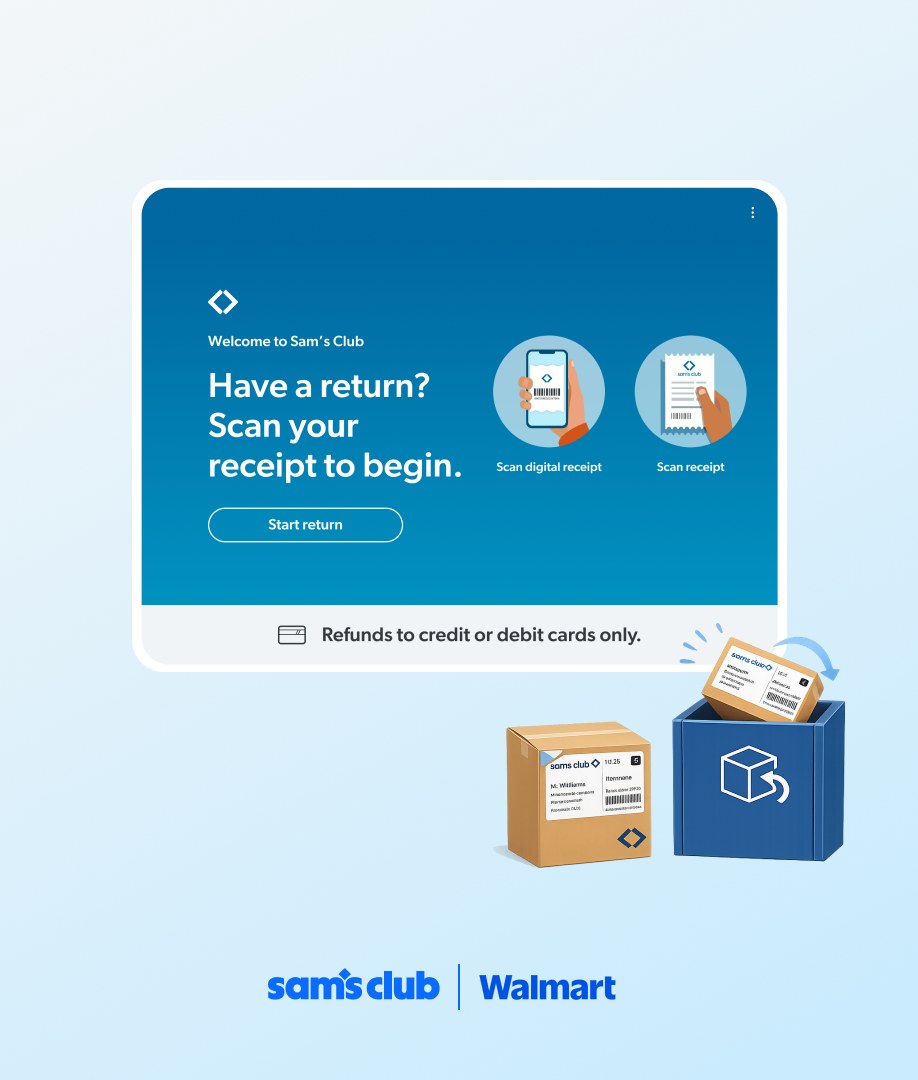
A self-service returns kiosk that lets members complete eligible returns on their own, with no waiting for an associate.
- Reduced pressure on the Member Services desk during peak periods
- Validated that members are willing to complete returns independently
- Generated operational insights that shaped the future returns strategy
Research & insights
Understanding where self-service could actually work. We paired in-club interviews with associates and a survey of members and non-members to learn how people navigated returns, where policy created uncertainty, and which moments still needed human judgment.
The interviews covered five associates who handled returns across two clubs. The survey reached 500 people who had made at least one return in the previous 12 months.
- 500survey respondents
- 5associates interviewed
- 2clubs
-
01
The real friction was ambiguity, not the transaction
Associates rarely referenced the written return policy. They relied on experience, managers, other associates and whatever appeared on their register, which led to inconsistent decisions from one return to the next.
Design implicationThe kiosk couldn't rely on members interpreting policy. The system had to determine eligibility.
-
02
Simple returns and exceptions needed different paths
Gift returns, missing purchase history, prohibited items and higher-value purchases were where associates most often needed judgment or a manager.
Design implicationAutomate the predictable. Route ambiguity and exceptions to an associate.
-
03
Members needed clarity before committing
Return requirements were a major source of confusion. What members most wanted to know up front was time limits, fees and item exceptions.
Design implicationSurface eligibility and exceptions early, so members know right away whether self-service will work for their return.
-
04
One queue was serving fundamentally different needs
A member making a straightforward return waited in the same line as someone who needed complex membership support.
Design implicationDon't optimize the queue. Give simple returns a way around it.
From in-club observation
Defining eligible
The goal wasn't to automate every return. It was to automate the right ones. The research drew a clear boundary between returns a system can decide and returns that need a person.
- Purchase identified
- Eligibility confirmed
- No policy exception
- No judgment required
- Purchase can't be identified
- Gift return
- Prohibited or non-returnable item
- Policy exception
- Manager judgment required
Associates specifically named gift returns and purchases missing from membership history as cases that needed workarounds or a manager. Managers were often brought in for items over $100.
How it works
One return journey, designed across digital and physical touchpoints. The experience didn't end at the screen. I designed the digital return flow alongside the physical service, from kiosk interactions and printed labels to signage, packaging, disposal and the final drop-off.