Gen AI · Contact center · 2023–2024

Turning conversations into context, in seconds.

A human-in-the-loop Gen AI experience that turns long member conversations into concise, actionable summaries, so advocates understand what happened without rereading the transcript.

✦The first Gen AI feature in the Sam's Club contact center
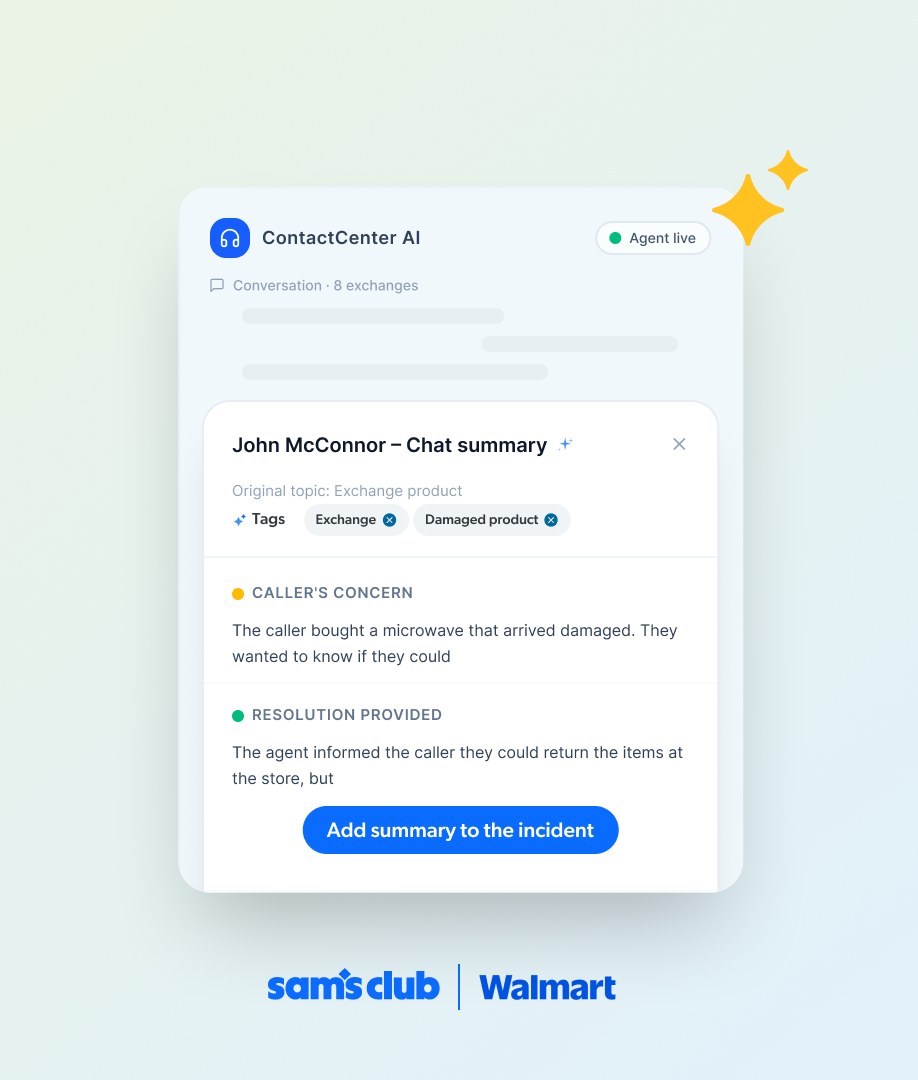
ContactCenter AI chat summary showing the caller's concern, the resolution and an Add summary to the incident button
Role
Lead Product Designer, Gen AI
Timeline
2023 design · 2024 go-live
Team
Product, engineering, data & ML, research, contact center operations
Part of
Advocate Unified Workspace
  • 8,110+AI summaries generated
  • ~70%accepted without edits
  • −7saverage handling time
  • ~$460Kestimated annual savings
01

The problem

Advocates were documenting the conversation while trying to have it. That created two kinds of cognitive load:

During a conversation

  • Capturing notes by hand while listening, troubleshooting and navigating the member's issue

Between conversations

  • Scanning long chat histories to piece together what happened, what was tried, and what comes next

How might we give advocates enough context to act, without asking them to read everything that came before?

02

How advocates read

They weren't reading transcripts. They were hunting for signals. Watching advocates work, we saw them scan every conversation for answers to the same three questions:

  1. 1

    What happened?

    What is the member contacting us about?

  2. 2

    What's been done?

    What troubleshooting, resolution or promises already happened?

  3. 3

    What's next?

    Is anything unresolved or needs follow-up?

InsightAdvocates didn't need a shorter transcript. They needed the conversation reorganized around decisions.

03

From summary to comprehension

  1. Compress
  2. Structure
  3. Prioritize
  1. V1 · Paragraph

    We started by compressing the conversation into one concise paragraph. It cut reading, but advocates still had to scan prose for what mattered.

    Shorter wasn't the same as scannable.

  2. V2 · Structured

    We reorganized around the advocate's mental model: predictable sections, Caller's concerns and Resolution provided, so they could jump straight to what they needed.

    Structure mattered as much as summarization.

  3. V3 · Signals

    Topic tags and visual hierarchy surfaced the key signals before advocates read a word of detail.

    The goal wasn't to read faster. It was to decide what deserved attention.
V1Paragraph summary
V2Structured summary
04

Designing trust into AI

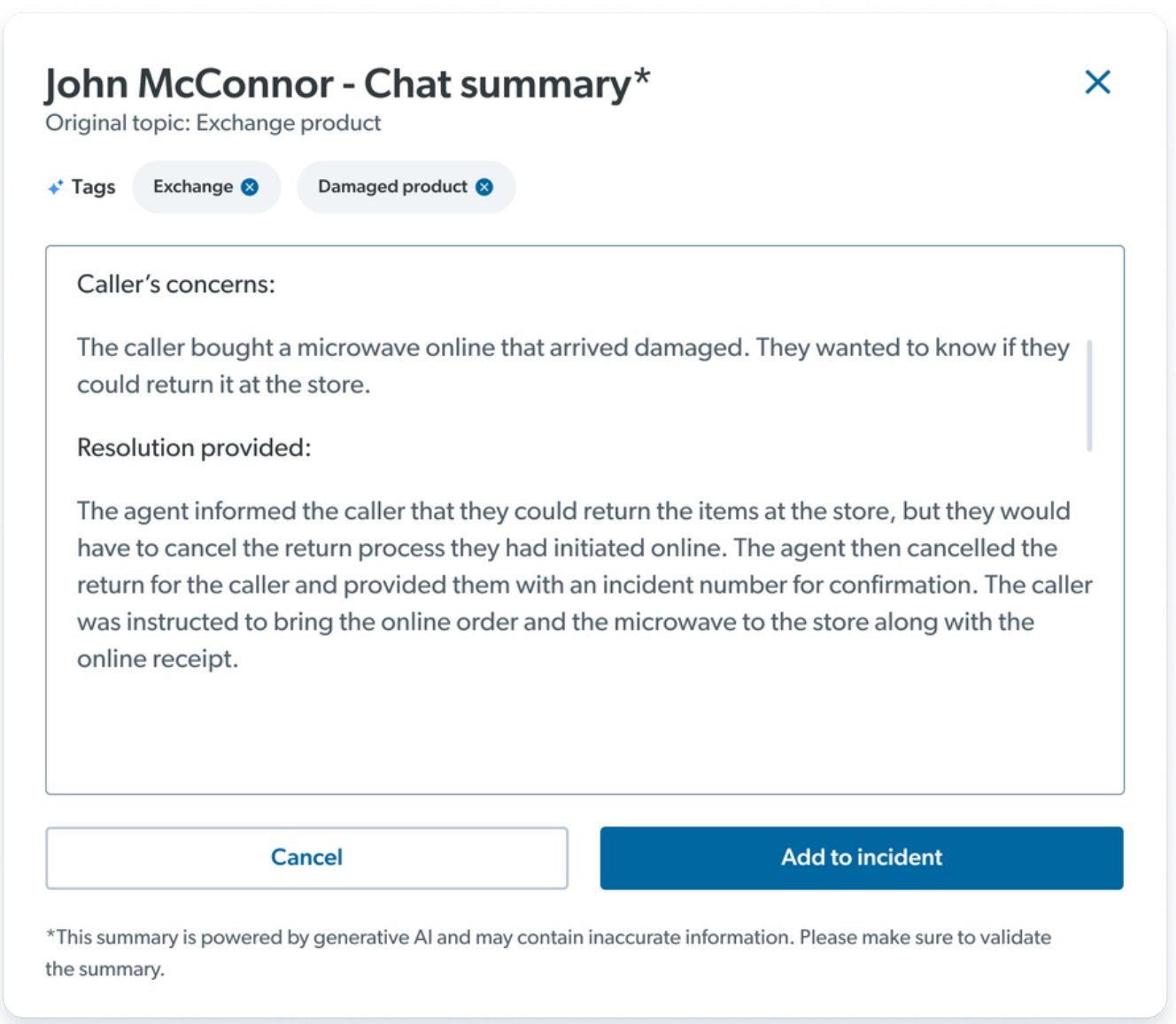
AI could write the summary. The advocate still owned the record. The question wasn't only “can AI summarize accurately?” but “what should happen when it doesn't?” So nothing is written into the member's permanent history without a person.

  1. 01

    Generate

    AI drafts the summary from the conversation.

  2. 02

    Review

    The advocate sees it first, with a clear note that it's AI-generated.

  3. 03

    Edit

    Fix anything missing or wrong in place, no regenerating.

  4. 04

    Confirm

    Only “Add to incident” saves it to the record.

AI proposes → Human verifies → System records

Chat summary card with topic tags, Caller's concerns, Resolution provided, Cancel and Add to incident buttons, and an AI disclaimer
Review and edit
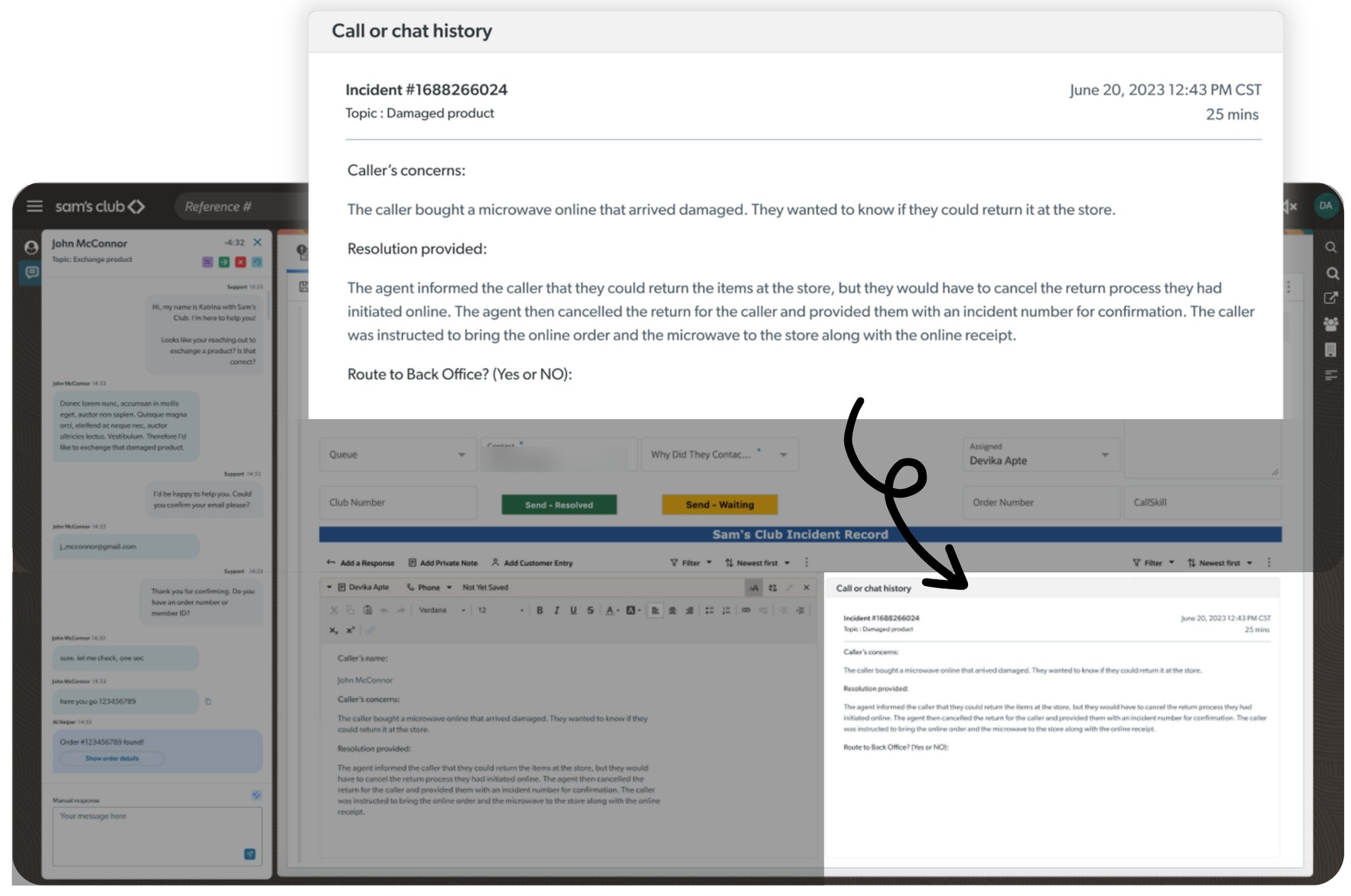
The confirmed summary saved into the incident's call or chat history
Confirmed, then recorded
05

When AI is wrong

Failure wasn't an edge case. It was part of the interaction model.

Incomplete
The advocate adds what's missing
Incorrect
Corrected before it's ever saved
Unhelpful
Cancel, and the original conversation is still there
AI-generated
Always labeled as such
Permanent record
Requires an explicit human confirmation

Trust didn't come from making AI look infallible. It came from making it correctable.

06

Measuring trust through behavior

Less documentation. Faster context. Human control intact.

8,110+AI summaries generated
~70%saved with no edits
~30%refined by advocates before saving
~$460Kestimated annualized labor savings

The ~30% isn't a failure rate. It's the editable workflow doing its job: advocates kept control where the AI fell short, and those edits show where the summaries can get better. Closing tickets with AI also took 7 seconds off average handling time.

“Another win for our contact center advocates and members. I love the path we are on with new self-serve and gen AI capabilities.”

Contact center leadership, at go-live
07

What's next

From summarizing the past to helping with what happens next.

Smarter structure
Summaries that adapt to each type of interaction
Quality signals
Learn why advocates edit, and feed it back into the experience and model
Cross-channel context
Continuity across chat, calls and past incidents
Next best action
Go beyond what happened to what to do next

The future isn't a better summary. It's an advocate experience that understands context, surfaces what matters, and moves the conversation forward.

Want the full walkthrough?

Some of this work is confidential. Send me an email and I'll share the full walkthrough.

Send an email ↗
More AI work

What if every AI answer adapted to how you read?

PACE AI: a self-initiated concept, now being built as a Claude plugin.

PACE AI